Home / The Machine Gun
The Machine Gun
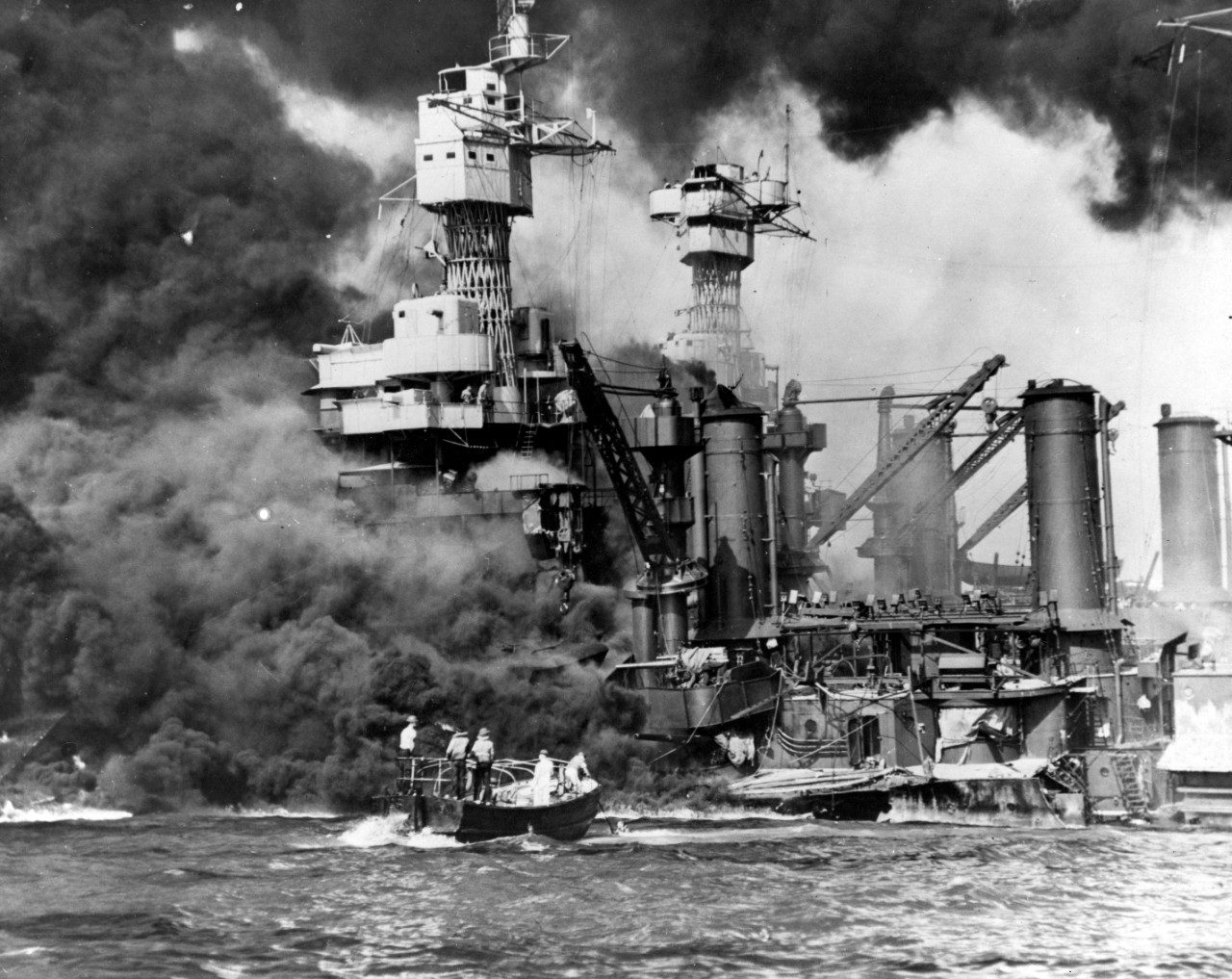
One sentence in one officer’s statement puts Doris Miller behind a gun on 7 December 1941. Everything else that is said about it — which gun, how long, how many aircraft — has to be measured against that sentence and two award citations.
Why this page exists
This is the most contested thirty minutes in the story, and the place where the gap between the documents and the popular account is widest.
The evidence
Everything rests on one sentence
There is exactly one contemporaneous document that places Miller behind a gun. It is enclosure (H) to the USS West Virginia action report: the statement of Lieutenant (junior grade) F. H. White, the officer at the adjacent mount, written four days after the attack and submitted up the chain of command.
Enclosure (H) — Statement of Lieut. (jg) F. H. White, D-V(G), U.S.N.R.
“Under direction of Lt. Ricketts, material to construct a stretcher on which to lower the Captain was procured, while D. Miller, Matt.2c. and I manned #1 and #2 machine gun forward of the conning tower.”
USS West Virginia (BB-48), Action of December 7, 1941 — Report of, BB48/A16-3, 11 December 1941, enclosure (H).
As evidence goes, this is strong. It is first-hand, it is contemporaneous, it names Miller by name and rating, and it comes from a man with no reason to invent it — White was reporting his own conduct, not writing a tribute. It also establishes only what it says: that two men manned two guns.
Rating
Mess Attendant Second Class. The Steward’s Branch carried no gunnery qualification of any kind.
Which gun
Number one and number two, forward of the conning tower
The report says “machine gun,” not a calibre. On a Colorado-class battleship in 1941 the guns in that position were part of the close-range anti-aircraft battery, and they are almost universally described in later accounts as .50-calibre Brownings. That identification is consistent and probably right, but it is an inference from the ship’s armament, not something the document states.
What the position tells us matters more than the calibre. These guns were mounted high, forward of the conning tower, on the same structure where Captain Bennion was lying mortally wounded and where Lieutenant Ricketts was organising the fire parties. Miller was not fetched from below to a gun; he was already there, having come up to the bridge, and the gun was in front of him.
Single-sourced claim
Had he been trained?
It is widely stated that Miller had a period of temporary duty aboard USS Nevada in July 1940 attending Secondary Battery Gunnery School, returning to West Virginia on 3 August 1940. This site has traced that claim to a single secondary source — an article in the U.S. Naval Institute’s Naval History magazine. It does not appear in the Navy’s own Dictionary of American Naval Fighting Ships entry, and no primary document confirming it has been located.
The claim is plausible and may well be correct. It is repeated online in near-identical wording, which usually indicates a single upstream origin rather than independent confirmation. The document that would settle it is Miller’s service record, Record Group 24, National Archives at St. Louis. Until someone reads it, this page treats the gunnery school as reported, not established.
What is not in doubt is that his rating carried no gunnery qualification. The Steward’s Branch was the only branch of the Navy open to Black enlisted men in 1939, and it trained men to wait tables, keep officers’ quarters and run the laundry. Whatever Miller knew about that gun, the Navy had not rated him to know it.
Two documents, two wordings
The commendation and the citation describe the same action in different words. Neither claims a result.
What the Navy said
The Navy described it twice, and never counted anything
Miller was recognised twice for 7 December 1941 — first by a letter of commendation from the Secretary of the Navy, then by the Navy Cross. The two texts are not identical, and the difference between them is instructive.
Secretary of the Navy to Miller, Doris, Mess Attendant First Class — 30 March 1942
“While at the side of his Captain on the bridge, MILLER, despite enemy strafing and bombing and in the face of a serious fire, assisted in moving his Captain, who had been mortally wounded, to a place of greater safety, and later manned and operated a machine gun until ordered to leave the bridge.”
Signed Frank Knox. National Archives, NAID 74876313, Record Group 24. No aircraft appear in this text at all.
Navy Cross citation — presented 27 May 1942
“…assisted in moving his Captain, who had been mortally wounded, to a place of greater safety, and later manned and operated a machine gun directed at enemy Japanese attacking aircraft until ordered to leave the bridge.”
Text as quoted in H.R. 2335, 119th Congress, and in Public Law 113-256. The citation adds what the gun was pointed at. It still does not say anything was hit.
That is the whole of the Navy’s written position. A gun was manned and operated. It was directed at attacking aircraft. Nothing was credited as destroyed — not in the commendation, not in the citation, not in any officer’s statement, and not in the action report.
Why it stopped
Not because the attack ended. Because the ready boxes were empty and the route to the magazine was under water.
How long
Until the ammunition ran out
No document gives a duration. What the statements do give is the reason the firing ended, and it is the same reason in two separate accounts. Lieutenant Ricketts records that all the ammunition in the ready boxes had been expended and that the ammunition train from below was flooded. Lieutenant (jg) White records going below to look for more and finding the route impassable.
Beattie, the navigator, put the length of the whole attack at about thirty minutes. Miller’s time at the gun was some part of that — after he reached the bridge, after Bennion was moved, and before the order to leave. The documents do not narrow it further, and neither should anyone else.
The numbers
Every figure in circulation, and where it comes from. None originates in a document written in 1941 or 1942.
The aircraft
Where the counts come from
No contemporaneous document credits Miller with destroying an aircraft. The numbers that circulate entered the record later, from press accounts, from recollections, and in one case from a state legislature.
| Claim | Where it appears |
|---|---|
| None credited | Navy Cross citation; Secretary of the Navy’s commendation, 30 March 1942; USS West Virginia action report and all eight enclosures |
| One | Attributed to Miller himself; the Texas State Historical Association records that he believed he had hit one |
| Two, possibly more | A National Archives educational newsletter, 2020 |
| Three, or six per some witnesses | Secondary reference works |
| Four | Texas House Resolution 1138, 75th Legislature, adopted 27 May 1997, which states he was “downing four enemy bombers”; also the figure Ronald Reagan used in 1975 |
| One to five | U.S. Naval Institute, Naval History, describing the range of estimates |
The Texas State Historical Association’s Handbook of Texas describes the plane claims as unverified, and its entry on Miller calls them almost certainly apocryphal. That is a state historical body reaching the same conclusion the Navy’s own paperwork implies by omission.
What can be said
That Doris Miller, holding a rating that barred him from any combat station, went to the bridge of a torpedoed and burning battleship, helped carry his mortally wounded captain out of the flames, and then operated an anti-aircraft machine gun at attacking aircraft until the ammunition was gone and he was ordered off. That is in the documents, and it is enough.
Sources
- USS West Virginia (BB-48), Action of December 7, 1941 — Report of, BB48/A16-3, 11 December 1941, signed R. H. Hillenkoetter. Enclosures (A)–(H), particularly (F), Lieut. C. V. Ricketts, and (H), Lieut. (jg) F. H. White.
- Secretary of the Navy (Frank Knox), Commendation to Miller, Doris, Mess Attendant First Class, 30 March 1942. National Archives, NAID 74876313, Record Group 24.
- Navy Cross citation, quoted verbatim in H.R. 2335, 119th Congress, and in Public Law 113-256 (18 December 2014).
- Texas State Historical Association, Handbook of Texas, entry for Miller, Doris.
- Texas House Resolution 1138, 75th Legislature, adopted 27 May 1997.
- U.S. Naval Institute, Naval History magazine, February 2016.
- U.S. Navy, The Negro in the Navy, Administrative History No. 84, 1947, on the Steward’s Branch as the only branch open to Black enlistment before 1 June 1942.
Quotations from the action report are taken from the HyperWar transcription; scans of the original typed pages are held by the Naval History and Heritage Command. The gunnery-school claim is single-sourced and marked as such above. Editorial policy · Report an error
PreviousDecember 7, 1941