Home / Pearl Harbor
December 7, 1941
Thirty minutes aboard USS West Virginia, reconstructed only from the action report and the eight officers’ statements filed with it — and an account of where those documents fall silent.
The berth
West Virginia lay outboard of Tennessee at Ford Island, with Arizona to the north-westward and Maryland south-westward. Being outboard is why she took torpedoes and Tennessee did not.
Before 0755
A Sunday morning, and a ship moored outboard
Almost everything written about Doris Miller describes the same half hour. Very little of it comes from the documents produced by the men who were there. This page uses those documents and nothing else, and says plainly where they stop.
USS West Virginia was a Colorado-class battleship, moored on the outboard side of a two-ship nest with USS Tennessee inboard of her, on the south-eastern face of Ford Island. Doris Miller, Mess Attendant Second Class, was twenty-two, in his third year of service, and had been collecting laundry when the first alarm sounded — a detail that comes from the Navy’s later accounts of the action, not from the action report, which does not describe his movements at all until he reaches the bridge.
Four days after the attack the ship’s senior surviving officer, Lieutenant Commander R. H. Hillenkoetter, submitted a five-paragraph report to the Commander in Chief, Pacific Fleet, with eight officers’ statements attached as enclosures (A) through (H). Together they run to a few thousand words. They are the closest thing that exists to a contemporaneous record of what happened aboard that ship, and they were written before anybody had a legend to protect.
Three accounts, one minute
Hillenkoetter says 0755. Ricketts says “about 0755.” White says “at 0756, approximately.” Beattie says “about five minutes to eight.” The convergence is itself evidence.
0755 – 0800
Away fire and rescue party
Four officers, writing separately, put the first alarm within sixty seconds of each other. Hillenkoetter was in his cabin dressing when the word was passed for the fire and rescue party; about thirty seconds later came general quarters, and the marine orderly rushed in to say the Japanese were attacking. Two heavy shocks were felt on the hull, seeming to come from somewhere forward on the port side. They were torpedoes.
Lieutenant Commander Beattie, the navigator, was finishing breakfast in the wardroom. Lieutenant Ricketts, the senior gunnery officer aboard, was at the same table. Lieutenant (junior grade) F. H. White heard the bugle from the wardroom and ran to the quarterdeck, where he saw a Japanese plane over a ship ahead of the West Virginia, a column of water and smoke rising.
The ship took three or four torpedo hits in the opening minutes. Oil and water went over the decks. Lieutenant Commander Harper, the damage control officer, reached Central Station and found the pendulum inclinometer off its scale; he estimated a maximum list to port of twenty-eight degrees. On the bridge, Ricketts asked the captain for permission to go below and counterflood. He got it, and did.
Enclosure (H) — Lieut. (jg) F. H. White, on Lieutenant Ricketts
“Had he not counter flooded, it is almost certain the West Virginia would have capsized as did the Oklahoma.”
The counterflooding is the reason the ship settled upright on the harbour bottom instead of rolling over. It is also the reason anyone on her upper decks — Miller included — had a deck to stand on.
Captain Mervyn S. Bennion
Commanding officer, USS West Virginia. Struck in the abdomen by a fragment, almost certainly from the bomb that hit Tennessee’s number three turret. He refused to be taken below and died on the bridge.
The captain
“He then sank to the deck, and I loosened his collar”
Beattie was standing beside Bennion when he was hit. The captain doubled up with a groan, said he had been wounded, and went down. Lieutenant (jg) White, who saw the wound later, recorded it in the flat language of a damage report: the abdomen cut, about three inches by four, part of the intestines protruding. Bennion stayed conscious and stayed in command, asking about the fires and about the oil on the water, and refusing to be moved below.
Lieutenant Commander Johnson, the communication officer, went up to the signal bridge and found the captain lying on a cot. He had brought someone with him for a specific reason.
Enclosure (D) — Lieut. Comdr. D. C. Johnson, Communication Officer
“I had brought a colored mess attendant with me — a very powerfully built individual, having in mind that he might pick the Captain up and carry him below.”
Johnson does not name the man. He is very widely assumed to be Miller, and Miller was demonstrably on that bridge within minutes; but the identification is an inference, not a statement in the document. This site marks it as such.
Ricketts listed who was on the bridge with him: Lieutenant (jg) F. H. White, Ensign V. Delano, Chief Signalman Siewart, Chief Pharmacist’s Mate Leak, “and Miller, D., Matt,2c.,” plus two or three signalmen. That single line, buried in a list of names, is the first appearance of Doris Miller in the documentary record of the attack.
What followed is described most fully in White’s statement. An improvised stretcher was built from a ladder. The captain’s stretcher slid aft with his head downward and the lashing came loose. White went to find something to cut it with; Ricketts came forward to look, followed by Miller and White.
Enclosure (H) — Lieut. (jg) F. H. White
“The four of us carried him aft and up to the Navigation Bridge where we laid him on deck under shelter of the port AA. director and out of the flame.”
Four men, one of them Miller. Bennion died there a short time later; Ricketts records Chief Pharmacist’s Mate Leak returning to him and finding him dead. Bennion received the Medal of Honor posthumously.
Which guns
Two .50-calibre Browning anti-aircraft machine guns mounted forward of the conning tower, above the bridge. Not a five-inch mount, and not a gun Miller had any rating to operate.
The guns
The one line everything else rests on
There is exactly one sentence in the entire report that puts Doris Miller behind a gun. It is worth reading slowly, because both what it says and what it omits have been argued about for eighty years.
Enclosure (H) — Lieut. (jg) F. H. White
“Under direction of Lt. Ricketts, material to construct a stretcher on which to lower the Captain was procured, while D. Miller, Matt.2c. and I manned #1 and #2 machine gun forward of the conning tower.”
This is a first-person account by the officer at the adjacent gun, written four days after the event and submitted up the chain of command. As primary evidence goes, it is about as good as this subject offers.
The gunfire did not last long, and the documents say why. Ricketts records that all the ammunition in the ready boxes had been expended and that the ammunition train from below was flooded. White records going below to look for more and finding the route impassable. The guns stopped because the ship ran out of rounds, not because the attack ended.
The Navy’s own account of the morning was set down on 30 March 1942, when the Secretary of the Navy, Frank Knox, signed a letter of commendation. It is the earliest official statement of what Miller is credited with doing, and it is worth reading against the popular version.
Secretary of the Navy to Miller, Doris, Mess Attendant First Class — 30 March 1942
“For distinguished devotion to duty, extraordinary courage and disregard for his own personal safety during the attack on the Fleet in Pearl Harbor, Territory of Hawaii, by Japanese forces on December 7, 1941. While at the side of his Captain on the bridge, MILLER, despite enemy strafing and bombing and in the face of a serious fire, assisted in moving his Captain, who had been mortally wounded, to a place of greater safety, and later manned and operated a machine gun until ordered to leave the bridge.”
Signed Frank Knox. National Archives, NAID 74876313. Note what the sentence does not contain: no aircraft, no count, no claim of a hit. The gun is simply manned and operated. Note also the address — by March 1942 Miller had been advanced to Mess Attendant First Class, and the letter was routed via the commanding officer of USS Indianapolis, the ship he was then serving in.
Miller received the Navy Cross from Admiral Nimitz two months later, on 27 May 1942. Neither that award nor any other Navy document credits him with destroying an aircraft.
Contested claim
The aircraft count
The Navy credited Miller with no aircraft, in the citation or anywhere else. Neither the Secretary of the Navy’s commendation of 30 March 1942 nor the Navy Cross citation of 27 May 1942 claims a single aircraft destroyed, and no officer’s statement in this report claims one either. Popular accounts give two, four, five or six; a 1997 Texas legislative resolution says four. None of those figures appears in a contemporaneous document.
The toll
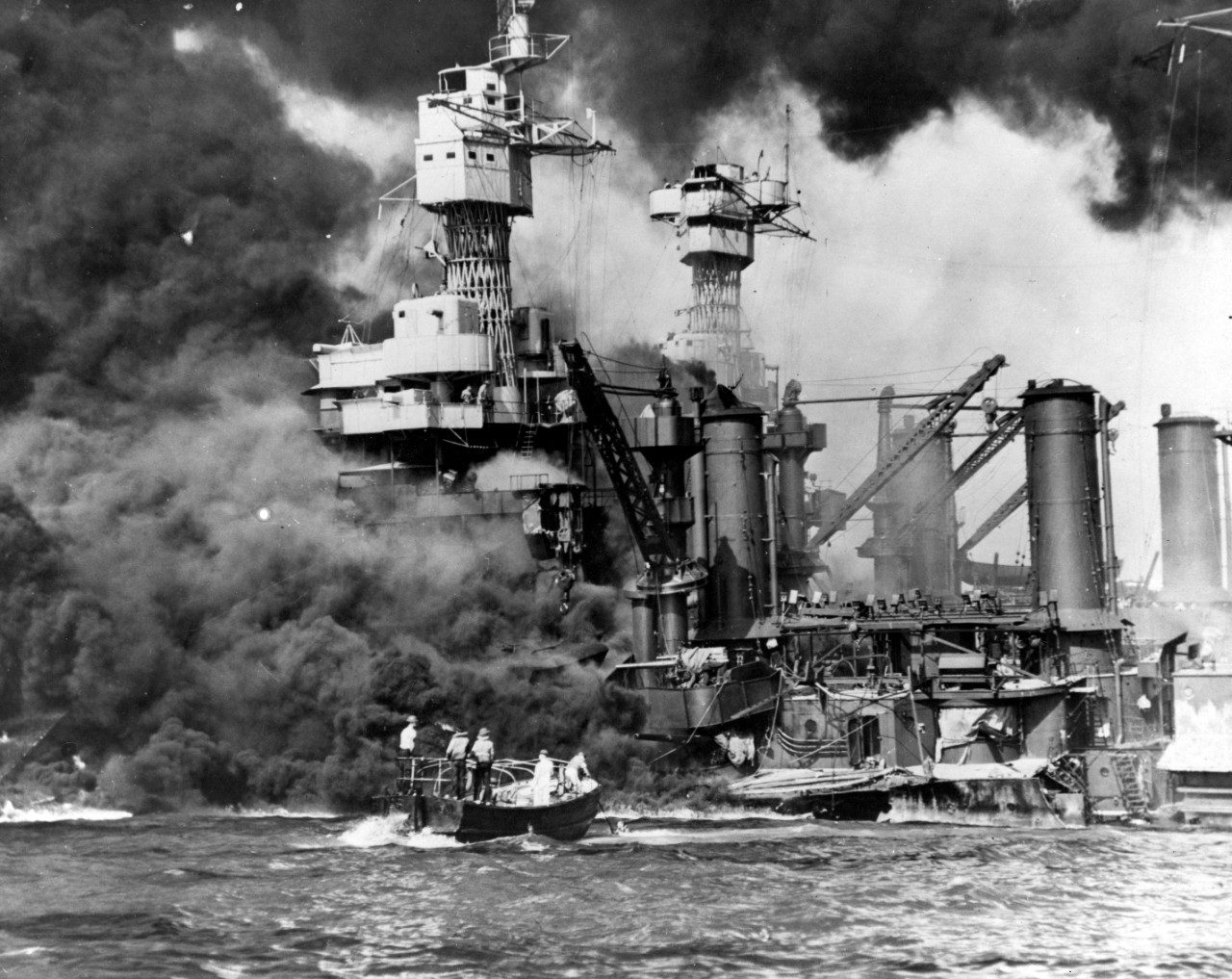
West Virginia lost roughly 106 of her crew. She was raised in 1942, rebuilt, and returned to the war — one of the few Battleship Row casualties to fight again.
After
Abandon ship, and a fire that burned until Monday
Burning oil from Arizona swept down the port side. Harper went below to the main deck and passed the word for all hands to abandon ship over the port bow. Men went into the water, onto Tennessee, and onto boats working alongside. Hillenkoetter himself dived overboard and swam to Tennessee, then organised a working party and went back aboard his own ship to fight the fire. Beattie put the length of the attack at about thirty minutes. The fires were not finally extinguished until Monday afternoon.
Hillenkoetter’s second paragraph names nine men for outstanding performance of duty: five lieutenant commanders and lieutenants, an ensign, a boatswain, Lieutenant (jg) White — and, inside the sentence about White, Doris Miller. He is the only enlisted man in the list.
- c. 0755“Away fire and rescue party” passed; general quarters about thirty seconds later. Two heavy shocks felt forward on the port side.
- 0756 – 0805Three or four torpedo hits. List to port reaches an estimated 28°. Ricketts obtains the captain’s permission and begins counterflooding.
- Early in the attackCaptain Bennion is struck in the abdomen by a fragment on the flag bridge and refuses to be taken below.
- Shortly afterArizona’s forward magazines explode. Burning debris rains on the West Virginia’s quarterdeck.
- Time not recordedMiller is on the bridge. He is one of four men who carry Bennion aft to the navigation bridge. No document times this.
- Time not recordedMiller and Lieutenant (jg) White man the two machine guns forward of the conning tower. No document gives a duration.
- Before the guns fall silentReady-box ammunition is expended; the ammunition train from below is flooded and cannot be reached.
- c. 0825Attack ends after roughly thirty minutes. Bennion is dead. The order to abandon ship over the port bow has been passed.
- 8 December 1941Fires aboard West Virginia finally extinguished Monday afternoon.
Why the gaps matter
A reference site that fills silences with plausible detail is indistinguishable from the sources it is trying to correct.
The limits
What these documents do not say
They do not say what time Miller reached the bridge. They do not say how long he fired, or in what direction, or whether he hit anything. They do not say who ordered him to the guns, or who ordered him away from them. They do not name the mess attendant Johnson brought up to the signal bridge. They do not describe his battle station, his movements before the bridge, or anything he said.
Almost every vivid detail in the popular version of this story lives in one of those gaps. Some of it may well be true. None of it is in the record filed on 11 December 1941, and this site will not present it as though it were.
Sources
- USS West Virginia (BB-48), Action of December 7, 1941 — Report of, BB48/A16-3, 11 December 1941, signed R. H. Hillenkoetter, Senior Surviving Officer. Enclosures (A) through (H).
- Enclosure (A) — Statement of Lieut. Comdr. J. S. Harper, U.S. Navy, Damage Control Officer and First Lieutenant.
- Enclosure (B) — Statement of Lieut. Comdr. T. T. Beattie, U.S. Navy, Navigator.
- Enclosure (D) — Statement of Lieut. Comdr. D. C. Johnson, U.S. Navy, Communication Officer, 10 December 1941.
- Enclosure (F) — Statement of Lieut. C. V. Ricketts, U.S. Navy.
- Enclosure (H) — Statement of Lieut. (jg) F. H. White, D-V(G), U.S.N.R.
- First endorsement, Commander Battleships, Battle Force, 13 December 1941, signed W. S. Anderson.
- Secretary of the Navy (Frank Knox) to Miller, Doris, Mess Attendant First Class, U.S. Navy, Commendation, 30 March 1942. National Archives, NAID 74876313.
- Navy Cross citation, Doris Miller, Naval History and Heritage Command.
- Official Military Personnel File, Doris Miller. National Archives.
- Dictionary of American Naval Fighting Ships, entry for West Virginia (BB-48).
Quotations are taken from the HyperWar transcription of the action report; scans of the original typed pages are held by the Naval History and Heritage Command, and the two have been compared. Where an officer’s statement and a later published account disagree, the statement is preferred. Wikipedia is not used as a source. Editorial policy · Report an error
PreviousWho Was Doris Miller
NextThe Machine Gun