Home / Navy Cross and Medal of Honor
Navy Cross and Medal of Honor
The Navy withheld his name for three months. A Black newspaper found it and printed it. What followed was a decoration, a refusal, and eighty years of bills that have never left committee.
The unnamed messman
For three months the most talked-about sailor in America had no name the public was allowed to know.
The campaign
A hero the Navy would not identify
In the weeks after Pearl Harbor the Navy released accounts of individual conduct, including that of an unnamed Black messman. It did not release his name. For the Black press this was the story: not only what the man had done, but that the Navy would not say who he was.
The NAACP’s executive secretary, Walter White, wrote to President Roosevelt and to Secretary of the Navy Frank Knox urging that the sailor be recognised. The Pittsburgh Courier, then the most widely read Black newspaper in the country, pressed hardest. It obtained the name and announced it in March 1942 — three months after the attack — with research assistance from Lawrence D. Reddick, curator of the Schomburg Collection at the New York Public Library.
What the Courier asked for is worth stating precisely, because it is usually described wrongly. Its central demand was not a medal. It was the abolition of the Navy’s rating restrictions. Its editorial line held that the greatest honour the Navy could pay Miller would be to strike the rules that had confined him to the Steward’s Branch in the first place, so that Black Americans could serve in any capacity. Later in 1942 it pressed for Miller to be brought home to tour, as white heroes were being toured.
A parallel campaign sought his admission to the U.S. Naval Academy. Black newspapers printed clip-out coupons addressed to Roosevelt. The Navy declined on age grounds — Miller was twenty-three, and candidates had to be between seventeen and twenty-one. That correspondence survives: Record Group 80 at the National Archives holds a file unit titled “Dorie Miller” within the series Correspondence Relating to Discrimination, 1941–1944.
Two texts
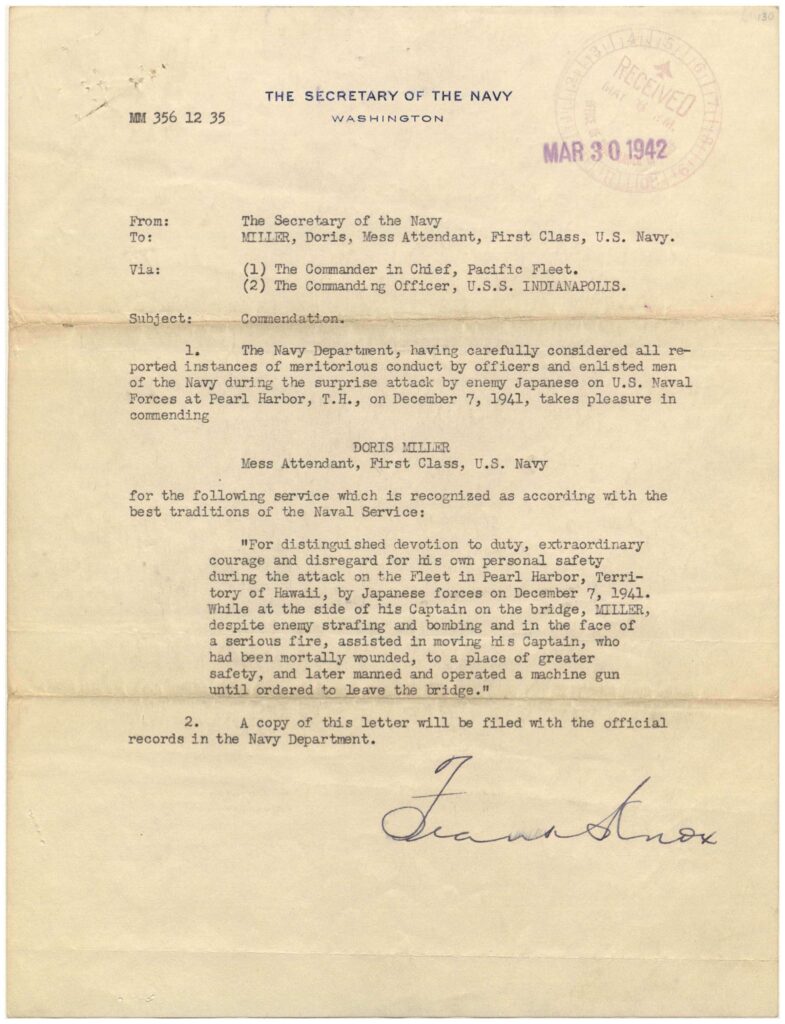
The commendation came first and says less. The citation came later and says more — but neither counts an aircraft.
The decoration
Commended in March, decorated in May
Miller was recognised twice. The Secretary of the Navy commended him by letter on 30 March 1942. Roosevelt approved the Navy Cross, and Admiral Chester Nimitz presented it at Pearl Harbor on 27 May 1942.
Navy Cross citation — 27 May 1942
“For distinguished devotion to duty, extraordinary courage and disregard for his own personal safety during the attack on the Fleet in Pearl Harbor, Territory of Hawaii, by Japanese forces on December 7, 1941. While at the side of his Captain on the bridge, Miller, despite enemy strafing and bombing and in the face of a serious fire, assisted in moving his Captain, who had been mortally wounded, to a place of greater safety, and later manned and operated a machine gun directed at enemy Japanese attacking aircraft until ordered to leave the bridge.”
Text as quoted verbatim in H.R. 2335, 119th Congress, and in Public Law 113-256 (18 December 2014). Note: a differently-worded version circulates on decorations databases, giving his rating as Mess Attendant First Class and opening with a standardised modern preamble. He held Mess Attendant Second Class at the time of the action. This site quotes the version Congress quotes and flags the discrepancy rather than choosing silently.
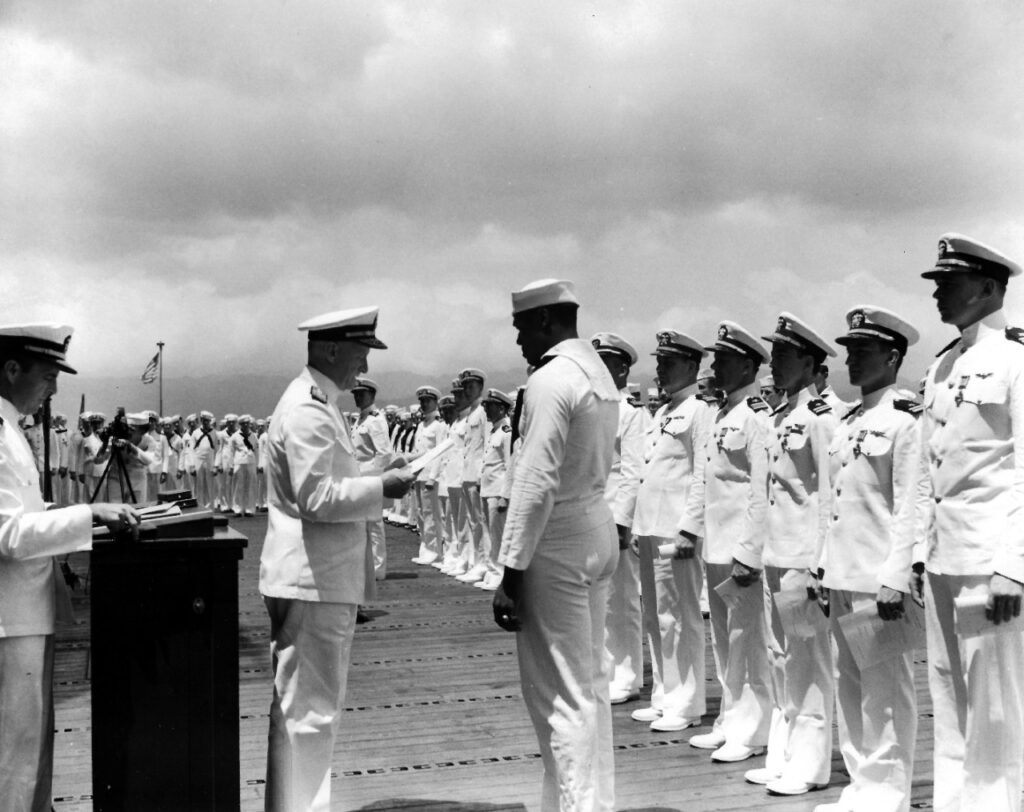
Nimitz, presenting it, said the award marked the first time in the conflict that such tribute had been paid in the Pacific Fleet to a member of his race, and that he was sure others would be similarly honoured.
The statutes
Act of 4 February 1919, 40 Stat. 1056.
Act of 7 August 1942, Pub. L. 77-702, 56 Stat. 743–745.
Precedence
In May 1942 the Navy Cross ranked third
This matters to how the award should be read. The Act of 4 February 1919, which created the decoration, enumerates the Navy’s awards in the order Medal of Honor, Distinguished Service Medal, Navy Cross — and the Navy Cross section expressly covers heroism or service “not being sufficient to justify the award of a medal of honor or a distinguished-service medal.” That subordinating clause is the evidence: in 1942 the Navy Cross sat third.
The Act of 7 August 1942 re-enumerated them as Medal of Honor, Navy Cross, Distinguished Service Medal, dropped the subordinating clause, and restricted the Navy Cross to extraordinary heroism in combat. Miller received his ten weeks before that change.
One caution, in the interest of precision: neither statute uses the word “precedence.” The elevation is carried by the re-ordering and the removal of the subordinating language, then implemented through Navy regulations. It is accurate to say the Navy Cross moved above the Distinguished Service Medal on 7 August 1942; it is not accurate to say the act declared a precedence, because it did not use that term.
Why not the Medal of Honor?
No Navy memorandum, board recommendation or statement explaining the choice has been located. Accounts of who objected disagree.
The refusal
What is documented, and what is not
Bills were introduced in 1942 to award Miller the Medal of Honor. They failed, and Roosevelt approved the Navy Cross instead. That much is stated by the Department of Veterans Affairs.
Beyond it, the record thins quickly. Secondary accounts variously name Representative Carl Vinson of Georgia, chairman of the House Naval Affairs Committee, as having opposed the award; some name Secretary Knox as well; one adds a rationale about the floor privileges that Medal of Honor recipients then enjoyed in Congress. These accounts do not agree with each other, and this site has not found a primary document behind any of them.
The names usually given for the 1942 bills — Representative John Dingell Sr. of Michigan and Senator James Mead of New York — rest on a single secondary source. The bill numbers could not be verified: GovInfo’s coverage of bill texts begins in 1993, and the 1942 Congressional Record was not reachable. Treat the 1942 legislative detail as reported rather than established.
Status
Every Medal of Honor bill has been referred to the House Armed Services Committee. None has been reported out.
Since
Eighty years of bills
Legislation to award Miller the Medal of Honor has been introduced repeatedly in recent Congresses. The status data below comes from GovInfo’s official bill-status records.
| Bill | Congress | Sponsor | Introduced | Outcome |
|---|---|---|---|---|
| H.R. 5549 | 116th | Rep. Eddie Bernice Johnson (D-TX-30) | 7 January 2020 | Referred to House Armed Services. 59 cosponsors. Died in committee. |
| H.R. 1251 | 118th | Rep. Kweisi Mfume (D-MD-7) | 28 February 2023 | Referred to House Armed Services. 23 cosponsors. Died in committee. |
| H.R. 2335 | 119th | Rep. Kweisi Mfume (D-MD-7) | 25 March 2025 | Referred to House Armed Services. 11 cosponsors. Still in committee. |
H.R. 2335 was introduced on National Medal of Honor Day. No Senate companion measure has been identified for any of the three. Separately — and not to be confused with these — Congressional Gold Medal bills were introduced as H.R. 6990 in the 117th Congress and H.R. 1252 in the 118th, both by Rep. Mfume. A Congressional Gold Medal is a different honour, awarded by Congress rather than by the President on behalf of the armed services.
A claim that a Medal of Honor measure has been introduced every year since 2015 appears in a congressional press release. This site could not verify it; no Medal of Honor bill was found in the 117th Congress.
Where it stands
Doris Miller has not been awarded the Medal of Honor. He holds the Navy Cross and a Purple Heart. The Congressional Medal of Honor Society’s roster of recipients for 7 December 1941 does not include him, and the fact that bills continue to be introduced is itself confirmation that the award has never been made.
Sources
- Navy Cross citation, quoted verbatim in H.R. 2335, 119th Congress (GovInfo) and in Public Law 113-256, 18 December 2014 (GovInfo).
- Secretary of the Navy, Commendation to Doris Miller, 30 March 1942. National Archives, NAID 74876313, Record Group 24.
- Act of 4 February 1919, ch. 14, 40 Stat. 1056.
- Act of 7 August 1942, ch. 551, Public Law 77-702, 56 Stat. 743–745.
- GovInfo bill texts and BILLSTATUS records: H.R. 5549 (116th), H.R. 1251 (118th), H.R. 2335 (119th), H.R. 6990 (117th), H.R. 1252 (118th).
- Congressional Record, 25 March 2025, introduction of H.R. 2335.
- Congressional Medal of Honor Society, Pearl Harbor Day recipients.
- National Archives, Record Group 80, Correspondence Relating to Discrimination, 1941–1944, file unit “Dorie Miller” (NAID 26416709).
- Department of Veterans Affairs, History Office, Doris Miller.
- U.S. Coast Guard, Book of Valor, 1945, on the Navy Cross as a combat-only award after 1942.
The 1942 bill numbers and sponsors, and the accounts of who opposed the Medal of Honor, are single-sourced or contradictory and are marked as such above. The settling documents would be the 1942 Congressional Record and Record Group 80. Editorial policy · Report an error
PreviousThe Machine Gun
NextThe Ships