Home / Biography
Who Was Doris Miller
A sharecropper’s son from McLennan County who joined the only branch of the Navy that would take him, and was dead at twenty-four. The half hour at Pearl Harbor is the part everyone knows. It is about one per cent of the life.
Birthplace
Sources differ. DANFS says simply Waco. The Handbook of Texas says Willow Grove. Waco’s own local history says a sharecrop farm at Speegleville. Willow Grove and Speegleville are both in ground now under Lake Waco, so the two may be compatible.
Waco
A farm now under a lake
Doris Miller was born on 12 October 1919 in McLennan County, Texas, the third of four sons of Connery and Henrietta Miller, sharecroppers. The story that his mother had expected a daughter, and that a midwife supplied the name, is repeated in Texas sources and is plausible; no document confirms it.
He worked his father’s cotton farm, and cooked in a Waco restaurant during the Depression. He attended the A. J. Moore school in Waco — the Navy’s own ship history calls it the Alexander James Moore Academy — where he played fullback. He was a big man: the physical descriptions that circulate put him around six foot three.
In September 1939 he went to Dallas and enlisted in the Navy. He was nineteen.
The policy, in the Navy’s own words
The Steward’s Branch “was the only branch in which Negroes could enlist until recruiting for general service was opened to them as of June 1, 1942.”
The Negro in the Navy, Administrative History No. 84, 1947
The Steward’s Branch
The only door that was open
Miller enlisted at the Naval Recruiting Station, Dallas, on 16 September 1939, as Mess Attendant Third Class, and did recruit training at Norfolk, Virginia. The rating was not a choice. General service had been closed to Black enlistment since shortly after the First World War; active recruiting into the Steward’s Branch resumed around December 1932, and that branch remained the only one open until 1 June 1942.
The Navy’s own 1947 administrative history sets out the scale of it. As of December 1941 the service counted six rated Black men in the regular Navy, twenty-three rated men who had returned from retirement, and fourteen in the Fleet Reserve. Mess attendants waited tables, kept officers’ quarters, and ran the laundry. They had no combat station and no gunnery rating.
Miller was first assigned to the ammunition ship USS Pyro (AE-1). He transferred to the battleship USS West Virginia (BB-48) on 2 January 1940 and served in her for very nearly two years. He is reported to have become the ship’s heavyweight boxing champion — a detail carried by the ship’s veterans’ association and by the U.S. Naval Institute, though it does not appear in the Navy’s official ship history, and no primary document for it has been found.
Covered in full elsewhere
This page summarises the morning. The reconstruction from the action report is on the Pearl Harbor page, and the evidence about the gun is on its own page.
7 December 1941
Thirty minutes
On the morning of the attack Miller was Mess Attendant Second Class, twenty-two years old, in his third year of service. West Virginia was moored outboard of Tennessee at Ford Island and took torpedoes in the opening minutes.
The action report of 11 December 1941 records him twice: once in a list of men present on the bridge, and once in the senior surviving officer’s summary of outstanding conduct, where he is the only enlisted man named. He helped haul wounded men through oil and water to the quarterdeck. He was one of four men who carried the mortally wounded Captain Mervyn Bennion aft to the navigation bridge. And with Lieutenant (jg) F. H. White he manned the two machine guns forward of the conning tower, until the ready ammunition was gone.
Advancement
Mess Attendant 3c → 2c → 1c → Ship’s Cook 3c. The dates of the later steps are poorly documented; his service record would settle them.
Afterwards
A cruiser, a tour, and a name in every Black newspaper
Miller left West Virginia on 13 December 1941, six days after the attack, and joined the heavy cruiser USS Indianapolis (CA-35), where he served roughly seventeen months. She was operating in the South Pacific through the early months of 1942; the Secretary of the Navy’s commendation of 30 March 1942 was addressed to him as Mess Attendant First Class and routed through her commanding officer.
He was still aboard her when the Pittsburgh Courier printed his name in March 1942, and when Nimitz pinned the Navy Cross on him at Pearl Harbor on 27 May 1942.
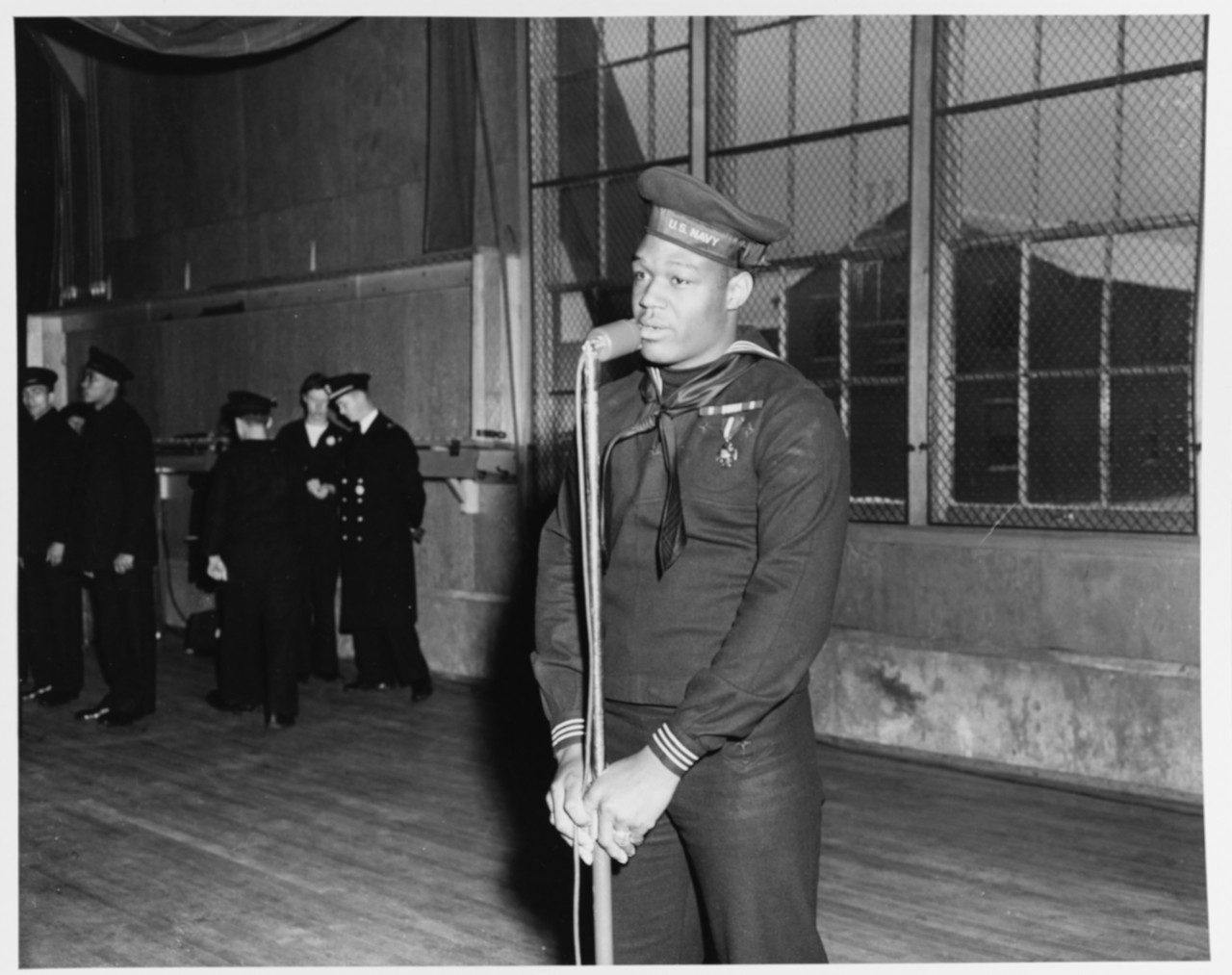
Between December 1942 and January 1943 he was brought home to tour — Oakland, Waco, Dallas and the Great Lakes Naval Training Station outside Chicago. Sources describe the tour variously as a war bond drive and as a recruiting drive; it appears to have been both. He was the first African American sent on it. At a San Francisco appearance in December 1942 he is quoted as saying that he had forgotten, in the moment, that he and other Black sailors could only be messmen in the Navy.
He was rated Ship’s Cook Third Class — a petty officer rating — in 1943, reportedly on 1 June, and joined the new escort carrier USS Liscome Bay (CVE-56).
Two dates, both correct
The ship sank on 24 November 1943. Miller was officially presumed dead on 25 November 1944, after the statutory year in missing status.
Liscome Bay
Twenty-three minutes off Butaritari
Liscome Bay was commissioned on 7 August 1943 at Vancouver, Washington, and became flagship of Carrier Division 24 under Rear Admiral Henry M. Mullinnix. In November she was supporting the landings in the Gilbert Islands — Operation Galvanic.
Before dawn on 24 November 1943, off Butaritari, the Japanese submarine I-175 put a torpedo into her. It detonated the aircraft bomb stowage. The Navy’s own war damage report is explicit that this, not the torpedo itself, destroyed the ship: the primary cause of loss was “the mass detonation of aircraft bombs stowed in the hold.” She was gone in about twenty-three minutes, a figure the damage report grounds in the logs of other ships in the formation. Mullinnix and her commanding officer, Captain Irving D. Wiltsie, were both killed.
Between 646 and 702 men died, depending on which official Navy source is consulted — the figures do not agree, and this site does not pretend otherwise. Miller was among them. He was twenty-four.
His parents were notified in December 1943 that he was missing. He was not officially presumed dead until 25 November 1944, one year and a day after the sinking, under the Navy’s rule for men in missing status.
Sources
- Dictionary of American Naval Fighting Ships, entry for Miller (DE/FF-1091) — the Navy’s official biographical sketch, covering birth, parents, schooling, enlistment, Pyro and the transfer to West Virginia.
- U.S. Navy, The Negro in the Navy, Administrative History No. 84, 1947, on the Steward’s Branch and Black enlistment.
- USS West Virginia (BB-48) action report, 11 December 1941, and enclosures.
- Secretary of the Navy, Commendation, 30 March 1942. National Archives, NAID 74876313.
- Texas State Historical Association, Handbook of Texas, entry for Miller, Doris.
- Department of Veterans Affairs, History Office, Doris Miller.
- National Museum of the Pacific War, “The Unforeseen Legacy of Doris Miller.”
- Dictionary of American Naval Fighting Ships, entries for Liscome Bay (CVE-56) and Indianapolis (CA-35).
- U.S. Navy, War Damage Report No. 45, USS Liscome Bay.
- U.S. Naval Institute, Naval History, February 2016.
- USS West Virginia veterans’ association service record summary.
Several biographical details commonly given as fact are single-sourced — the boxing championship, the July 1940 gunnery school, and the advancement dates. They are flagged in the text rather than presented flatly. Miller’s official military personnel file, Record Group 24 at the National Archives in St. Louis, would settle most of them. Editorial policy · Report an error
PreviousHome
NextDecember 7, 1941