Home / The Ships
The Ships
Three he served in, one named for him, and one still being built. Where the Navy’s own sources disagree about them — and on two of these ships they disagree badly — this page shows the disagreement rather than picking a winner.
Berth F-6
Outboard of Tennessee, with forty feet of water under her keel. Being the outboard ship is why she took torpedoes and Tennessee did not.
BB-48
USS West Virginia
A Colorado-class battleship, built at Newport News, commissioned 1 December 1923. Miller joined her on 2 January 1940 and left on 13 December 1941. She is the ship of the story.
On 7 December 1941 she was moored at berth F-6 on the south-eastern face of Ford Island. She was torpedoed in the opening minutes, took bomb hits, and settled upright on the harbour bottom — upright only because Lieutenant C. V. Ricketts obtained the captain’s permission and counterflooded. Lieutenant (jg) F. H. White’s statement puts it plainly: had he not counterflooded, it is almost certain she would have capsized as Oklahoma did.
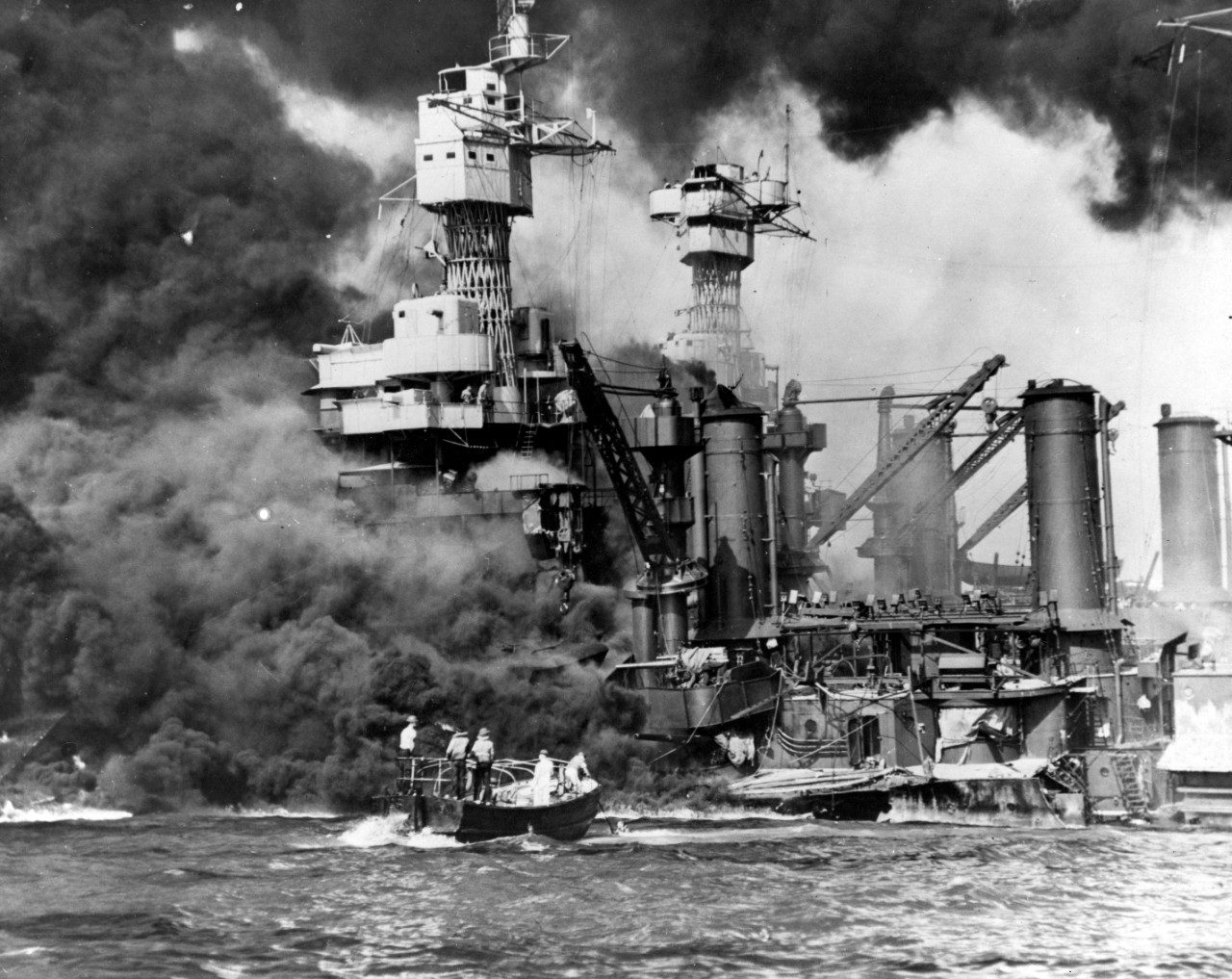
Official sources disagree
How many torpedoes hit her?
Four U.S. Navy sources give four different answers.
| Count | Source |
|---|---|
| Three or four | The ship’s own action report, 11 December 1941 — a contemporaneous estimate made by men who had just been through it |
| Six and two bombs, or four and four | Report of Salvage — a post-salvage forensic assessment, which offers two alternative reconstructions and commits to neither |
| Seven and two bombs | Dictionary of American Naval Fighting Ships — the standard modern figure |
| Up to nine | Naval History and Heritage Command photographic section |
Seven is the figure to use if one must be chosen, but it should be presented as the Navy’s later determination rather than as an uncontested fact. The count was revised upward as salvage proceeded.
She was refloated on 17 May 1942 and docked on 9 June. Sixty-six bodies were recovered during salvage — a figure not to be confused with her total dead, which was over a hundred. She was rebuilt at Puget Sound with a streamlined superstructure and a modern anti-aircraft battery, and went back to the war. She fired at Surigao Strait during the battle of Leyte Gulf, and was at Iwo Jima and Okinawa. She earned five battle stars, and she was in Tokyo Bay on 2 September 1945 for the surrender. Decommissioned 9 January 1947; sold for scrap in 1959.
Seventeen months
Longer than he served in West Virginia after the attack, and almost never mentioned.
CA-35
USS Indianapolis
A Portland-class heavy cruiser, commissioned 1932. Miller joined her on 13 December 1941, six days after the attack, and served in her for roughly seventeen months — the longest posting of his career after West Virginia, and the one almost every account of his life skips.
She was busy while he was aboard: engaging Japanese aircraft near Rabaul in February 1942 and raiding Lae and Salamaua in New Guinea in March. The Secretary of the Navy’s commendation of 30 March 1942 was routed through her commanding officer, which is how we know where Miller was that month.
She later became Admiral Spruance’s Fifth Fleet flagship, delivered components of the first atomic bomb to Tinian in July 1945, and was torpedoed by I-58 on 30 July 1945, sinking in twelve minutes. Of 1,195 aboard, 316 survived. Miller had left her more than two years earlier.
Cause of loss
Not the torpedo. The bombs it set off.
CVE-56
USS Liscome Bay
A Casablanca-class escort carrier built by Kaiser at Vancouver, Washington. Keel laid 12 December 1942; commissioned 7 August 1943, Captain Irving D. Wiltsie commanding. Flagship of Carrier Division 24 under Rear Admiral Henry M. Mullinnix. She lasted three and a half months.
In November 1943 she was supporting the Gilberts landings — Operation Galvanic. Before dawn on 24 November, off Butaritari, the submarine I-175 under Lieutenant Commander Tabata Sunao hit her with a torpedo abaft the after engine room.
War Damage Report No. 45 — conclusion
“…the primary cause of the loss of the vessel was the mass detonation of aircraft bombs stowed in the hold, frames 152 to 168…as a result of heavy fragment attack produced by a contact torpedo explosion.”
The torpedo did not sink her. It set off her own bomb stowage. The same report records that she had disappeared some 23 minutes after the explosion, as logged by other vessels in the formation — the best-grounded of the competing figures. DANFS says 28 minutes.
The casualty figures do not agree
This is not a case of popular accounts differing from official ones. Three U.S. Navy sources disagree with each other, and two of them are publications of the same command.
| Killed | Survivors | Source |
|---|---|---|
| 702 | not stated | War Damage Report No. 45 — contemporaneous primary document |
| 683 | 265 | Dictionary of American Naval Fighting Ships (NHHC) |
| 646 | 272 | National Museum of the U.S. Navy (NHHC) |
The DANFS figures do not reconcile arithmetically against the complement it gives. This site reports the range — 646 to 702 — and names each source, because that is what the evidence supports. Mullinnix and Wiltsie were both lost. So was Doris Miller. I-175 was sunk on 4 February 1944.
Sponsor
Henrietta Miller, his mother, christened the ship named for her son.
DE-1091 / FF-1091
USS Miller
A Knox-class destroyer escort built at Avondale Shipyards, Westwego, Louisiana. Laid down 6 August 1971; launched 3 June 1972, sponsored by Mrs. Henrietta Miller, his mother; commissioned 30 June 1973 under Lieutenant Commander Lynn P. Blasch.
She was reclassified a frigate, FF-1091, on 30 June 1975. She made her first Mediterranean deployment in 1975, took part in Operation Fluid Drive — the evacuation of citizens from Beirut — in the spring of 1976, and worked NATO exercises through the 1980s. Transferred to the Naval Reserve Force in 1982, decommissioned 15 October 1991, struck from the Naval Vessel Register 11 January 1995.
Her final disposal is reported as a transfer to Turkey under grant aid on 31 December 1998 — as a parts hulk, not as a serving warship. That distinction matters, and several popular accounts get it wrong by implying Turkey sailed her. The source for the disposal is a hobbyist reference rather than an official record, and this site marks it as reported until the Naval Vessel Register confirms it.
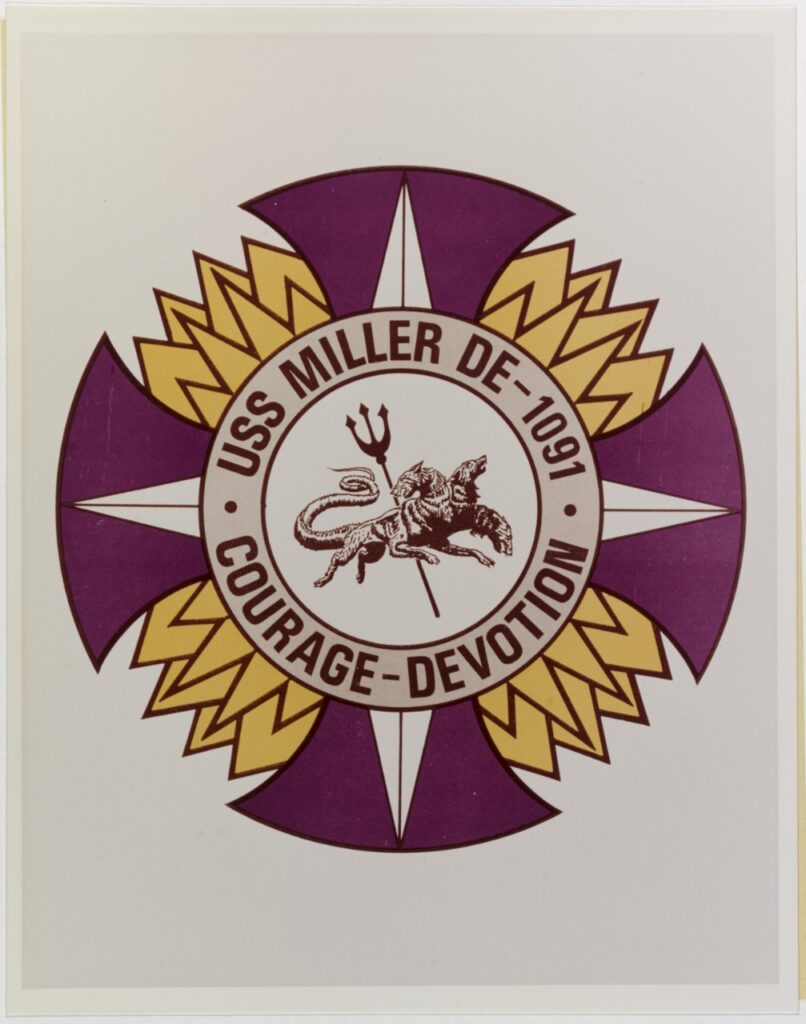
Her ship’s insignia — a purple cross with gold lightning, and the motto Courage · Devotion — is held by the Naval History and Heritage Command as NH 79367-KN.
Status
Steel cut 25 August 2021. Keel not yet laid as of May 2026. Delivery moved from February 2032 to February 2034.
CVN-81
The future USS Doris Miller
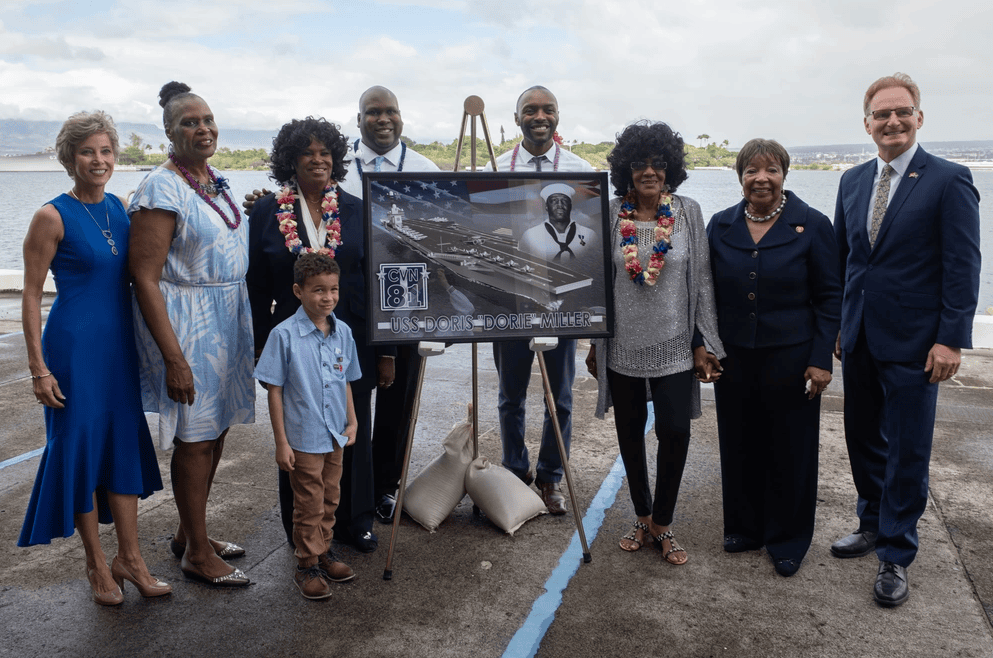
On 20 January 2020 — Martin Luther King Jr. Day — Acting Secretary of the Navy Thomas B. Modly announced at a ceremony at Pearl Harbor that the fourth Gerald R. Ford-class aircraft carrier would be named for Doris Miller.
The Navy’s press release makes two claims, and they are not equivalent. The first is unqualified: this will be “the first aircraft carrier ever named for an African American.” The second is carefully worded: “the first aircraft carrier to be named in honor of a Sailor for actions while serving in the enlisted ranks.” That is narrower than the popular paraphrase, “first carrier named for an enlisted sailor,” and the Navy’s own sentence is the one worth quoting.
She is being built by Newport News Shipbuilding, bought in a block with CVN-80. The ceremonial first cut of steel was on 25 August 2021. As of May 2026 the keel had not yet been laid; the shipbuilder expected to host the keel laying during 2026. Delivery has slipped two years, from February 2032 to February 2034, which the Navy attributes to construction footprint constraints and the shipbuilder attributes to the knock-on effect of delays to CVN-80.
Developing — unconfirmed
Reports of a possible renaming
On 21 August 2026 several outlets reported that the Navy is internally considering renaming CVN-81 in honour of Donald Trump. As of the last review date on this page:
No renaming has taken place. The ship’s official name remains USS Doris Miller. The reporting originates with a CNN exclusive citing three anonymous sources; at least one outlet that carried it stated that it could not independently confirm it, and a Pentagon official said there was nothing official to announce. One unnamed source claimed the Navy had internally stopped using the name.
This site will record the outcome when there is a documented one. Until then this paragraph describes unconfirmed reporting of internal deliberations, and should be read as such.
Sources
- Dictionary of American Naval Fighting Ships: West Virginia (BB-48), Indianapolis (CA-35), Liscome Bay (CVE-56), Miller (DE/FF-1091).
- USS West Virginia (BB-48) action report, 11 December 1941, and enclosures (F) and (H).
- USS West Virginia, Report of Salvage. Naval History and Heritage Command online reading room.
- U.S. Navy, War Damage Report No. 45, USS Liscome Bay (CVE-56).
- National Museum of the U.S. Navy, USS Liscome Bay (ACV/CVE-56).
- Naval History and Heritage Command photographic section, USS West Virginia and USS Tennessee during the Pearl Harbor attack.
- U.S. Navy press release, “Navy Names Future Aircraft Carrier Doris Miller During MLK, Jr. Day Ceremony,” 20 January 2020.
- Huntington Ingalls Industries, first cut of steel, 25 August 2021.
- U.S. Naval Institute News, “Future Aircraft Carrier Doris Miller Delayed by 2 Years,” 8 May 2026.
- Military.com, report of possible renaming, 21 August 2026 — cited as unconfirmed reporting, not as established fact.
The disposal of USS Miller (FF-1091) and the CVN-81 renaming reports are both marked as unconfirmed above. The Naval Vessel Register would settle the first. Editorial policy · Report an error
PreviousNavy Cross and Medal of Honor
NextTimeline